




7 tips on taking better photos for social media
There are several different components that make up a successful social media page, but one of the most important is quality imagery. As a marketing agency, social media can be one of the best places to engage our audience. That’s why we understand the importance of a great photo.
We don’t need expensive cameras to take quality photos. Our cell phones can take such high-quality photos, and most people can’t tell if they are taken with a phone or professional photography equipment. The camera can’t do all the work, though.
There are a few key tips to keep in mind while you’re trying to capture that Kodak moment.
#1 — Light it Right
Lighting is one of the most important tools you can utilize when taking photos. An easy tip to remember is to ensure your subject isn’t backlit, and that the light is shining down on it directly or coming at it from an upper-diagonal angle. If the light hits it from the back, you’ll be left with a dark, indiscernible green smoothie bowl, which is social media blasphemy.
You can combat this in a few ways:
- The first way is to make sure your light source is coming from behind you (facing the subject).
- You can also take the photo in HDR mode.
- The third option is to fix it in post-production.
#2 — Shoot in HDR Mode
HDR stands for High Dynamic Range. In HDR mode, the camera will typically take two, three, or more photos at different exposures in quick succession, and then blend them together into one image with detail in both highlights and shadow.
Smartphone cameras that have the HDR feature usually offer the option to switch the HDR setting to On, Off, or to set it to Auto-HDR. Having HDR set to “On” tells your phone to capture a high dynamic range image every time a photo is taken.
#3 — Understand Depth of Field
Creating depth of field with your phone camera is a really cool way to up your Instagram photo game. When you’re shooting, always take into consideration the foreground, middle ground, and background in relation to the subject of the photo.
Let’s say you’re taking a picture of a subject some distance away from you and you want the subject in focus and the background blurry — simply tap your subject and wait for a yellow square to appear. Shooting in portrait mode on your phone is a great way to effectively highlight the depth of field, too.
#4 — Learn the Rule of Thirds
Rule of thirds, also known as the golden grid rule, is a technique where a composition is aligned to a three-by-three grid.
By dividing a composition into three grids, we section it into nine imaginary rectangles with four intersections. The focus subject is aligned at one of the intersecting points or close to them. This creates an asymmetry in the composition.
In Settings, tap Camera, and then enable the Grid option. That’s all you have to do to turn the feature on! Your next step is to apply the concept: remember to put important things along the lines.
#5 — Have Fun With Camera Angles
Playing with unique angles can help your photos stand out and offer you a variety of options to choose from when it comes time to post. Angles can create the illusion of depth and height, making your images more interesting to look at, thereby generating more views.
TIP: Try lowering the angle to create a new perspective instead of shooting straight down.
#6 — Use Negative Space Appropriately
Negative space is the area surrounding the main subject in a photograph that is left unoccupied. Basically, it’s the space around the subject that helps define the positive space (or main focus).
Leaving a large amount of negative space in the photo can emphasize scale and simplicity, but make sure you are using it correctly.
TIP: If you’re trying to highlight the subject in the photo, make sure you’re taking the photo close up and filling the frame with the subject. This will reduce the surrounding negative space.
#7 — Tasteful Phone Editing
We could break down each category of editing you can utilize on your phone, but for simplicity’s sake, we want to highlight the three tools that can really elevate your photo:
- Brightness: It’s always a safe bet to bump up the brightness a bit unless your photo is already over-exposed. Indoor lighting rarely provides you with adequate illumination for a decent photo.
- Contrast: Adjusting the contrast ever so slightly helps to make the darks darker and the lights lighter. This can help your image appear less “flat.”
- Saturation: Delicately increasing the saturation will help to bring out some of those vivid colors that poor lightning may have counterbalanced. Make sure to not overdo this one or you will end up with some radioactive colors.
With over 4.6 billion people around the world using social media, online engagement is higher than ever. That is why it is so important to have content that is not only engaging but aesthetically pleasing. Take each one of these tips into consideration the next time you are taking a photo with the intention to post and you’ll look like a pro in no time.
And the Mad Men Marketing production crews are always ready to step in and help elevate your content for you! So, are you ready to interact? If so, reach out to our team today by calling 904-355-1766!
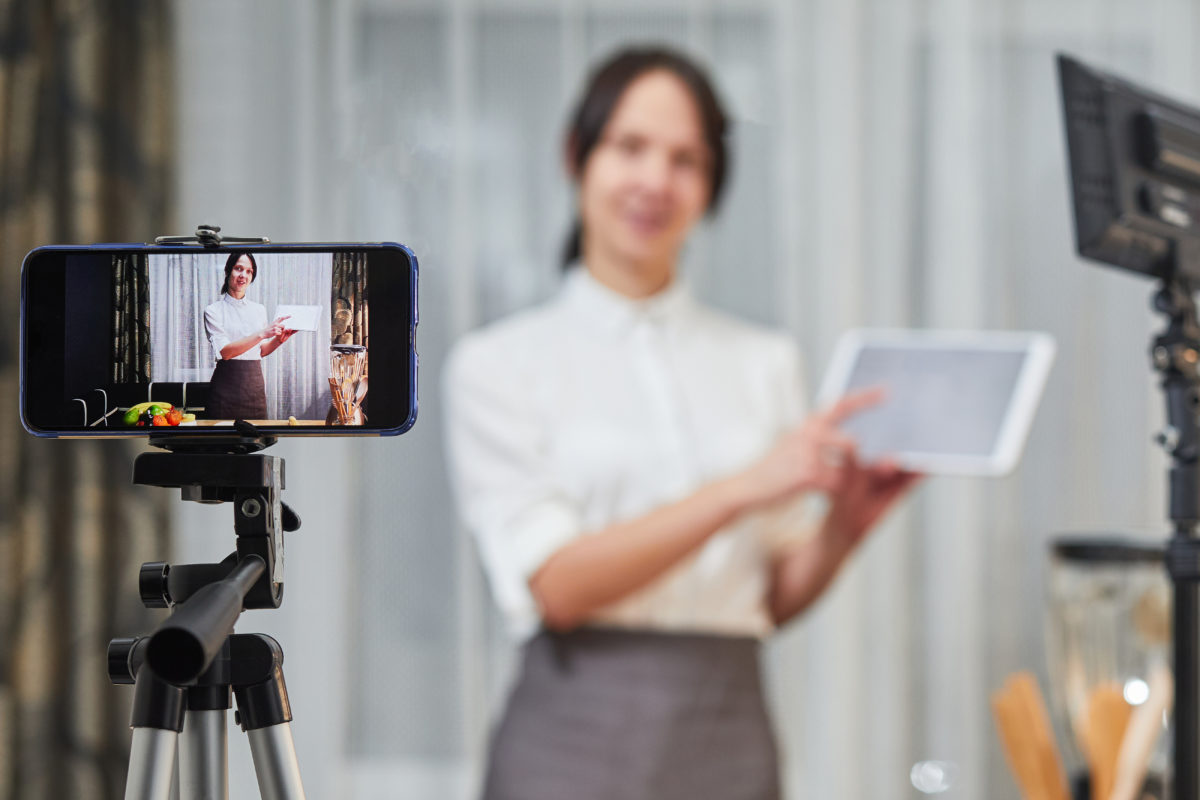
4 Tips for Shooting Video of Yourself on Your Phone
- Setting
-
- Choose a space that is well-lit with as little background noise as possible.
- Avoid spaces where you will be back-lit, such as sitting in front of a window or a lamp, as this could cause you to be silhouetted and difficult to see. Position yourself to keep your main light source in front of you.
- Also, avoid spaces where there would be distracting clutter in the shot.
- Framing your shot
-
- Position the camera at your eye level to avoid shooting yourself at high or low angles, and keep yourself centered in the frame.
- Use a tripod to keep your camera steady. Some selfie sticks come with a built-in tripod. If you don’t have this equipment available, then propping up the phone on a flat surface can work.
- Front or back-facing camera
The back-facing camera on your phone will provide higher quality video due to a better lens and higher megapixels. But if you prefer to be able to see yourself as you shoot, then you can use the front-facing camera.
KEEP IN MIND: As you’re shooting, keep eye contact with the lens as if it’s the person you’re talking to.
- Hitting the record button
-
- Give yourself a couple of seconds after you hit the record button to start talking. This will give the final video editor room to splice in your video and transition between others.
- Be sure to smile before you start talking and after you finish.
- Speak clearly and avoid muttering or trailing off as you talk.
- Some more helpful tips
-
- Keep water on hand (but make sure you can’t see it in the shot) for when your mouth or throat get dry.
- Avoid wearing jewelry that can make noise, like bangled bracelets.
- Don’t be too hard on yourself. Most people get nervous being on camera and it can take multiple tries to get it right!
The Three Steps Involved in Creating a TV Commercial
“It is expected that TV advertising revenue in the United States will grow … to 81 billion [dollars] in 2025,” Statista reports. And oh, we know: you want in on that.
But without experience behind the camera — let alone walking meticulously through each step of commercial advertising — you might (understandably) not know where to start.
So, if you’re looking for a basic three-step rundown on the commercial creation process to help you get prepared, simply read on with us:
Step One: Pre-Production
Pre-Production is the planning phase that involves brainstorming, establishing a vision, writing the initial script, and creating a shooting script and/or storyboard.
The difference between a shooting script and a storyboard is that…
- A shooting script is written descriptions of visuals that will be captured to represent the content of the script
- A storyboard includes drawn thumbnails or illustrations to convey what those shots will look like.
Otherwise, in addition to the aforementioned, pre-production may also include “hiring the actors and crew, finding locations, determining what equipment you’ll need, and figuring out the budget,” as explained by MasterClass.
Step Two: Production
Production is precisely what you might expect it to be: it is the process of going on location or into a studio in order to capture all of the video/audio content that will be in the commercial.
This includes shooting scenes with the required actors/talent, capturing any B-roll content to be spliced in, and recording audio (such as voiceovers or custom music).
And remember, when you’re deciding what that content should be, always hone in on the interests in passions of your target audience. This is because “video viewers said relating to their passions is 3X more important than content featuring famous actors,” as reported by Google.
Step Three: Post-Production
Post-production is where everything comes together in the process of editing.
Production specialists will use video editing software to cut together the best shots from the footage that was captured before laying in the audio bed, which includes:
- Voice
- Sound effects
- Music
“Additionally, this is the point at which any other visual elements — like motion graphics — will be added in order to create the final product according to the established vision during the pre-production process,” Mad Men Marketing Director of Production Tamara Dileo says.
And remember: if you aren’t sure what story or message you want to convey on-screen, you’re not alone — Mad Men Marketing is ready to help you adjust your focus!
From photography to videography and more, we’re eager to get behind the camera and help you capture your brand’s vision. After all, our research-driven and content-inspired agency believes that your television commercial should help you to interact with your audience, not interrupt them.
So, are you ready to interact? If so, reach out to Mad Men Marketing today by calling 904-355-1766!

Best Practices for a Creative and Productive Day!
As creators, we can’t always control our creative flow and, consequently, our productivity level. Fortunately for us, there are practices we can implement that just might increase creativity and production in our daily lives.
Here are a few that we recommend:
Get in Touch with Your Intuition
Albert Einstein called the intuition “a feeling for the order lying behind the appearance.” There are patterns in our daily lives, organic ways in which the world moves that we can tune into and harness for our own creations.
Tuning into this natural flow allows us to arrive at conclusions that just make sense. When you can’t find anything new in the patterns around you, ask questions about them. If this doesn’t work, it may be time to switch up your environment: go play.
Shake Up the Pattern
“Our brains are constantly changing, they’re adapting, they’re learning, they’re dynamic,” according to Dr. Sahar Yousef, a UC Berkeley-trained cognitive neuroscientist. “It’s truly a canvas, and you can change and manipulate, depending on what you’re exposing your brain to. You can create different associations.”
You don’t have to go as far as taking a vacation to the other side of the world, but maybe change up your routine a little bit: go for a jog before sunrise, take a drive through a different side of town, listen to a new artist or playlist. There are plenty of ways we can find new perspectives and patterns we never thought about before. Although these changes can spur creativity, it’s not always good for the production side of things.
Keep Your Work Area for Work
“What is important here is intentionality in the environments we choose to do specific types of activities,” Yousef says. So, while switching up your daily pattern can help spur creativity, keep your actual work area for focused productivity so that your brain doesn’t get confused.
When we start allowing copious amounts of emails, meetings, calls, or even meals to interrupt our productivity time, we are training our brains to multitask instead of focus on the task at hand. Set aside some time for these distractions outside of where you are productive so that when you get back to your productivity space, your brain knows it is time to focus.
Mad Men Marketing 2014 NFL Mock Draft
1. Houston Texans – Jadeveon Clowney (DE South Carolina) For some reason, everyone seems to think that Houston really wants to go QB here. Quarterback IS the most important position on the field, but none of the quarterbacks in this year's class are worthy of the #1 overall pick. For that reason, how can you possibly pass up the opportunity to pair JJ Watt with Jadeveon Clowney. This is a total no-brainer. All of the other rumblings HAVE to be smoke and mirrors.
Jadeveon Clowney
2. St. Louis Rams – Sammy Watkins (WR Clemson) I think this is the last year Sam Bradford gets to legitimately make things work. Adding Watkins to a receiving corps that already has Tavon Austin could really open up the passing game. Ultimately I think the Rams trade this pick and get a tackle. There are a lot of people that would like to leapfrog the Jaguars if they suspect they'd take a QB.
Greg Robinson
3. Jacksonville Jaguars – Khalil Mack (LB/DE Buffalo) Ideally, the Jags would have loved it if Clowney fell into their laps, but Mack is one heck of a consolation prize. In fact, he may turn out to be the better pro in my opinion, (no one has questioned his effort) and his measureables are off the charts for a defensive end/rush linebacker. Think Von Miller with better size.
Blake Bortles
4. Cleveland Browns – Johnny Manziel (QB Texas A&M) I think Cleveland is the perfect place for Manziel to BEGIN his career. Cleveland could use some positive exposure and that's precisely what they'll get as long as Manziel can keep his nose clean off the field. This is more than a PR move, however, Manziel can definitely sling the ball downfield, and he's the best I've ever seen at rolling right and throwing the ball across his body to the left to find the open receiver (a lot of scouts would say this is ill-advised). I don't think he's a running QB; I think he runs to throw and he should have a top-tier target in Cleveland when he arrives. He's close friends with Lebron James and Lebron had a decent start to his career in Cleveland.
Sammy Watkins (Buffalo Bills)
5. Oakland Raiders – Blake Bortles (QB UCF) I think this pick has the potential to be traded, not to the degree that the #2 pick does, but I wouldn't be surprised if Oakland traded back. Matt Schaub will be 33 before the season starts, so he's not the future. Pryor got traded to Seattle for a pittance. I think the raiders let Bortles learn a couple of years behind Schaub and make the first intelligent move they have in a long time. Bortles has the body and the poise to excel. Sadly, he doesn't have the name (seriously, say it 3 times and see if it sounds like a Pro Bowler to you) and I know that sounds silly, but it's the vibe I get and it's my mock draft, not yours.
Khalil Mack
6. Atlanta Falcons – Greg Robinson (OT Auburn) It's an absolute tragedy that Atlanta is even drafting this low. I know they need a pass rusher, but they might be able to snag another Auburn player a little later for that specific purpose (MAYBE). Robinson is an absolute mauler at tackle and could help anchor an offensive line that protects one of my favorite passers, Matt Ryan. With proper coaching and improved footwork, Robinson could be a perennial Pro Bowler.
Jake Matthews
7. Tampa Bay Buccaneers – Jake Matthews (OT Texas A&M) Safe and smart. A trade could be possible here, with Tampa moving back.
Mike Evans
8. Minnesota Vikings – Derek Carr (QB Fresno State) Christian Ponder is a model of mediocrity and his uppance has come. Carr has the fastest release I've seen in this year's QB class.
Justin Gilbert (Cleveland Browns)
9. Buffalo Bills – Mike Evans (WR Texas A&M) Stevie Johnson has lost a step and EJ Manuel needs a legitimate #1 option
Anthony Barr (Minnesota Vikings)
10. Detroit Lions – Darqueze Dennard (CB Michigan State) People have been mocking CBs to Detroit forever. Maybe someday they'll draft one. Dennard has the ability to turn picks into points each time he snatches a pass out of the air.
Eric Ebron
11. Tennessee Titans – Justin Gilbert (CB Oklahoma State) Gilbert and Dennard are kind of like #1 and #1A CBs. A lot of people have Gilbert mocked ahead of Dennard.
Taylor Lewan
12. New York Giants – Eric Ebron (TE UNC) Quick! Name your favorite New York Giants tight end moment…….NOTHIN'. Ebron can change all that.
Odell Beckham Jr.
13. St. Louis Rams – Ha Ha Clinton-Dix (S Alabama) The Rams haven't had a dominant safety since Aeneas Williams. Dix is a physical guy who could really get the secondary going.
Aaron Donald
14. Chicago Bears – Taylor Lewan (OT Michigan) There has been a revolving door along the front five. Lewan has the size and the pedigree to anchor the line.
Kyle Fuller
15. Pittsburgh Steelers – Louis Nix (DT Notre Dame) This big tackle has the girth and power that have become a hallmark of the Pittsburgh Steelers defense over the years.
Ryan Shazier
16. Dallas Cowboys – Kony Ealy (DE Missouri) Ealy could definitely go earlier than this. He has a lot of upside and a high motor. It's a shame the Cowboys have a huge hole to fill with Ware's departure.
Zack Martin
17. Baltimore Ravens – Calvin Pryor (S Louisville) It seems the Ravens are constantly reimagining their secondary. The front 7 are amazing, but this is where their focus should be.
C.J. Mosley
18. New York Jets – Brandin Cooks (WR Oregon State) Think Santana Moss in his prime when you think of Brandin Cooks ceiling. Could be a game-changer like Desean Jackson.
Calvin Pryor
19. Miami Dolphins – CJ Mosley (LB Alabama) Remember when Zach Tomas was wreaking havoc at Middle Linebacker in Miami. Mosley could be the guy that leads the league in tackles as a ROOKIE.
Ja'Wuan James
20. Arizona Cardinals – Teddy Bridgewater (QB Louisville) Most don't have Bridgewater falling this far, and if he does, some teams will probably be salivating over a potential trade. This would be a great fit and Teddy would remain a Cardinal.
Brandin Cooks (New Orleans Saints)
21. Green Bay Packers – Aaron Donald (DT Pittsburgh) This guy has been climbing draft boards and if that holds true, he will be drafted as high as 10.
Ha Ha Clinton-Dix
22. Philadelphia Eagles – Kelvin Benjamin (WR Florida State) This would help ease the pain of losing Jackson and would give the Eagles another red zone threat next to Riley Cooper.
Johnny Manziel (Cleveland Browns)
23. Kansas City Chiefs – Zack Martin (OT Notre Dame) With the losses along the line and the addition of Fisher, this could give the Chiefs two young bookend tackles.
Dee Ford
24. Cincinnati Bengals – Dee Ford (DE Auburn) POTENTIALLY the best DE in the draft. Played against top tier competition and knows how to really bring it.
Darqueze Dennard
25. San Diego Chargers – Kyle Fuller (CB Virginia Tech) Not incredibly confident about this pick, but the Chargers need help on defense, badly.
Jason Verrett
26. Cleveland Browns – Odell Beckham (WR LSU) It seems like a foregone conclusion that the Browns will be selecting a QB/WR tandem to team up with their amazing WR.
Marcus Smith (Philadelphia Eagles)
27. New Orleans Saints – Marqise Lee (WR USC) Make no mistake, Lee is a playmaker and the Saints have had the same stable of receivers FOREVER!
Deone Bucannon (Arizona Cardinals)
28. Carolina Panthers – Davante Adams (WR Fresno State) With the departure of virtually every legitimate receiver, a target for Cam Newton has to be a top priority.
Kelvin Benjamin
29. New England Patriots – Tim Jernigan (NT Florida State) No Vince Wilfork makes this an easy selection.
Dominique Easley
30. San Francisco 49ers – Anthony Barr (LB/DE UCLA) The 49ers have the luxury of drafting based on potential. Barr is a pass rusher that used to be a runningback. Think Brandon Jacobs with more speed.
Jimmie Ward
31. Denver Broncos – Jason Verrett (CB TCU) I, personally, like Verrett better than Fuller, but think he'll be perfect in Denver.
Bradley Roby
32. Seattle Seahawks – Ryan Shazier (LB Ohio State) I would be a LITTLE surprised if Shazier were still here, but if he is, he may not be for long.
Teddy Bridgewater (Minnesota Vikings)